AN ENTERPRISE AI BUYER'S GUIDE
How to evaluate a governed AI platform.
Most AI evaluations grade the wrong things: features that demo well and fall over in production. This is the framework we'd use if we were buying, not selling. We build one of these platforms, so we have a horse in this race. We've written it to be useful anyway.
THE CRITERIA
Grade every vendor on these six. Including us.
A feature checklist tells you what a tool can demo. These six tell you whether it survives production, an auditor, and your third year of use.
Apply them to everyone on your shortlist - the answers separate a governed platform from a conversational layer bolted onto a database.
01 · Centralised business logic.
Is there one definition of each metric, enforced everywhere — or does every team rebuild "margin" in its own spreadsheet? Ask to see where a KPI is defined, and what happens when it changes. If the answer is "in each report," you don't have a platform, you have a habit.
02 · Governance & explainability.
Can any answer be traced back to a governed definition, audited, and defended to a regulator? Ask the vendor to show you the lineage of a single number, end to end. "The AI said so" is not an audit trail.
03 · PII protection.
Is client personal data protected before it reaches the model — structurally, in the architecture — or after, by policy and access rules? Ask whether PII can enter the inference pipeline at all. Policy-dependent protection is a promise; architectural protection is a fact.
04 · Data volume at scale.
Does performance degrade as data grows? Ask what happens at ten times the dataset.
Tools built on in-memory imports or spreadsheet engines hit a wall; tools that fetch only the filtered shape they need don't.
05 · Enterprise system integration.
Can it connect to the systems you actually run?
The non-Microsoft ERP, the SAP-and-Salesforce reality — or only to its own ecosystem? Ask what a client running two vendors' systems sees. Two disconnected data streams is not one governed view.
06 · Single source of truth.
Can other systems, reports, and AI agents read from it as a governed source - or is it a consumption layer that reads from wherever the data already lives? Ask whether the tool can be queried by something downstream, not just whether it can query. A dead end is not a foundation.
SIDE BY SIDE
How three common approaches answer them.
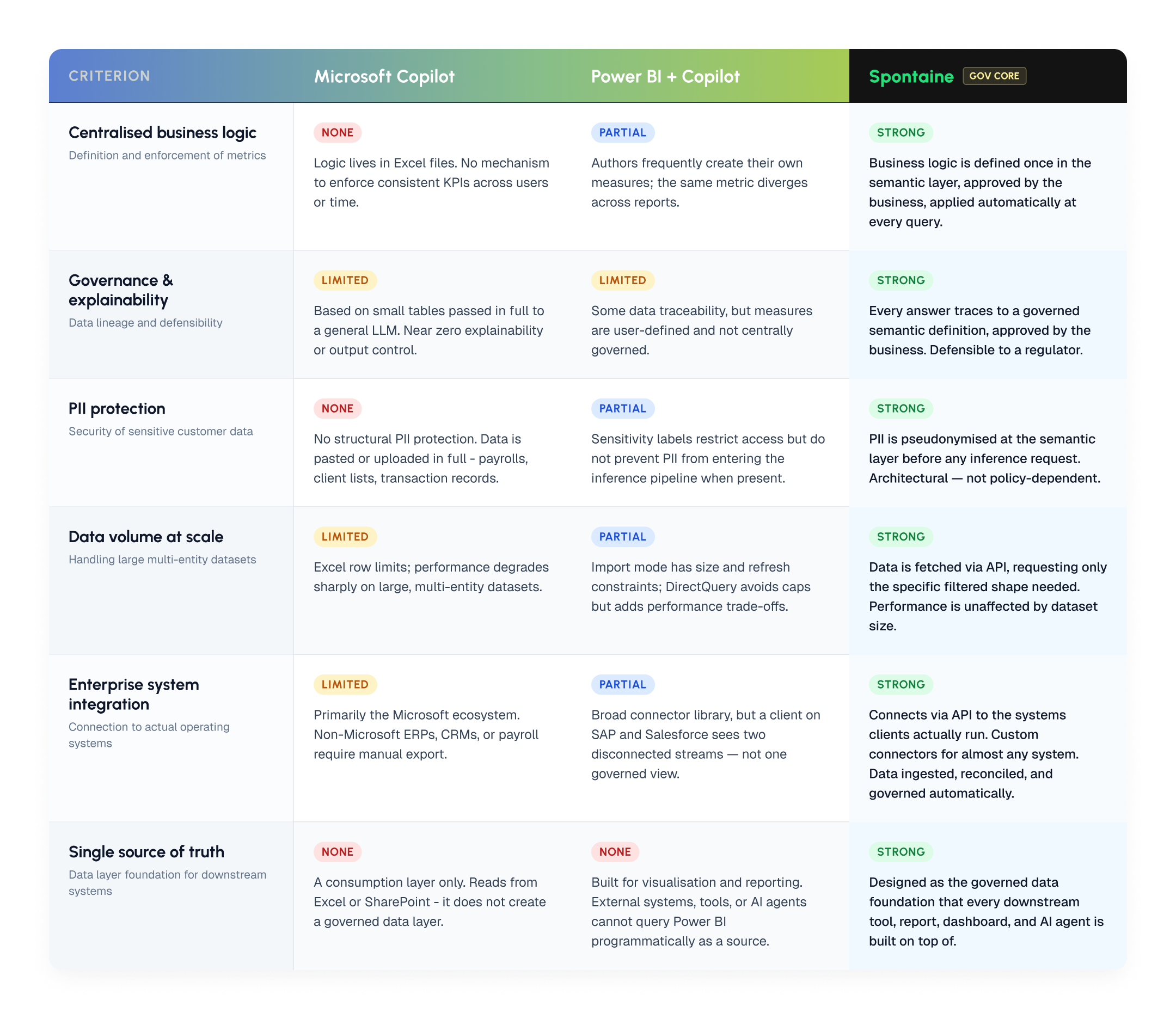
No rip-and-replace required - Spontaine augments the most common industry stack rather than replacing it. Here's how the same six questions land against Microsoft Copilot, Power BI with Copilot, and Spontaine.
THE COMMON CASE
If you're already on Microsoft..Keep it. Point it at us.
Most teams evaluating this are already on the Microsoft stack, and the instinct is to frame it as a switch. It isn't one. Spontaine works beneath Power BI, not instead of it - Power BI stays exactly where it is and reads from a governed source instead of a contested extract. Your reports don't change. What changes is that they stop disagreeing with each other. The same is true of Copilot, your ERP, your CRM. Nothing is ripped out. Spontaine is the governed layer the rest of your stack was missing, not a replacement for the parts that already work.
THE HONEST PART
Two things we're not the answer to.
Pixel-level report design.
If your need is flexibly bespoke visual reports, Power BI or Tableau is better at that than we are, and it will stay better. Keep it for that, but pointed at us.
A long track record.
We're newer and smaller than the platforms you're comparing us to. If a decade of deployment history is your first filter, we won't pass it, and you should weigh that honestly.
From the field
The row nobody puts on the scorecard:The number that shows up in year two.
Feature grids compare what a tool does. They rarely compare what it costs once the whole organisation is using it .
That's the row that decides the budget. Ungoverned AI gets more expensive the more people use it, because it regenerates the same intelligence on every query. A governed platform doesn't: the work is done once and reused.
In practice, that's the difference between a pilot that quietly becomes a seven-figure production line item and one that doesn't.
Spontaine lands flat, because cost stops scaling with usage once intelligence becomes infrastructure.
Bring your own scorecard.
You've probably started building your comparison already. Bring it. Tell us the rows you're grading on. We'll tell you which ones we win, which ones we lose, and which ones we think are the wrong rows to be grading on at all. No deck, nothing to buy.
Start with the decision. Build from there.